This website uses cookies.

Learn more. Accept.
→
Αντιγράφηκε η διεύθυνση email

Event Category: Theater

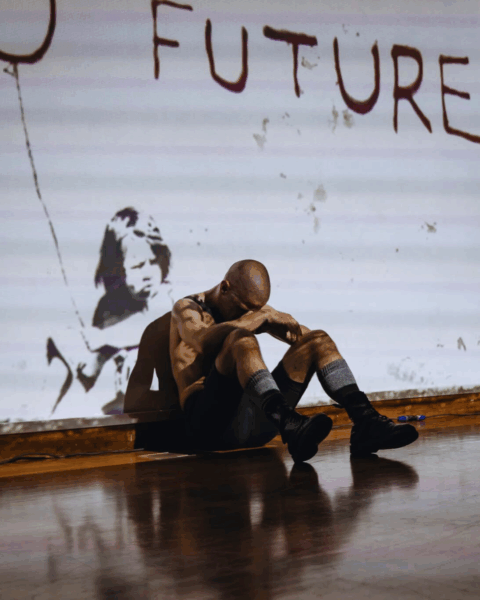
THE DEATH OF AN ACTOR

Alt text

Dulcinea Compania
The Death of an Actor
Inspired by the short story “The Death of a Government Clerk” by Anton Chekhov
Directed by Anna-Maria Iakovou

Dulcinea presents “The Death of an Actor,” directed by Anna-Maria Iakovou, a performance inspired by three short stories by Anton Chekhov. Beginning with the famous sneeze of the civil servant Chervyakov in The Death of a Government Clerk, the performance brings Chekhov’s universe into the contemporary reality of the artist, where social devaluation and insecurity often turn into an internalized sense of guilt. Two actors, a musician and a civil servant create a theatrical landscape that moves between theatre and performance, echoing the memory of old travelling theatre troupes, while exploring with irony and tenderness the burden of public exposure and the fragile position of artists in today’s world.

The performance “The Death of an Actor” is presented under the auspices and with the financial
support of the Hellenic Ministry of Culture.


Biography of Dulcinea Compania

Dulcinea Compania was founded with the aim of creating artistic actions, research initiatives, and educational activities. It has received funding from the Ministry of Culture (2022–2025) and has collaborated with the Embassy of Spain in Athens, Los Torreznos, the ThessFringe Festival, Metaichmio Publications, among others. The group has participated in the Thessaloniki Biennale (“#thehead | On Becoming an Animal” by Panos Sklavenitis), while its performances have been presented at Plyfa, Theatre 104, Pikap Kato, Theatre Aneton, Space Lab, Artbox Fargani, Romantic University of Athens, Tavros Art Space, and other venues.

More information: www.dulcineacompania.gr

Duration: 70 minutes
Recommended age: 12+

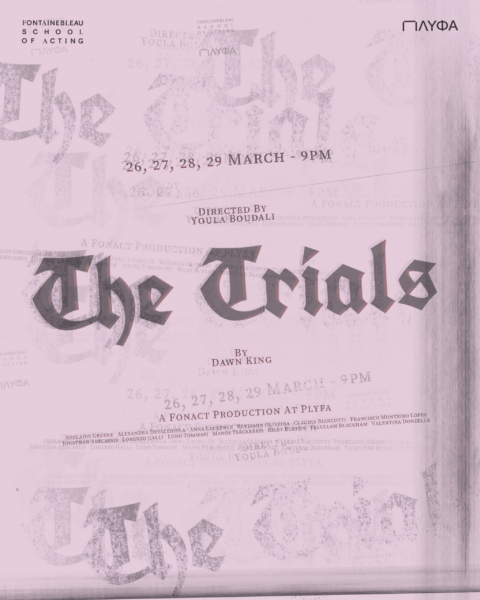
THE TRIALS

Alt text

The Trials
by Dawn King
A FONACT production
Directed by Youla Boudali

 Everyone lived like we did… I wasn’t any worse than anyone else.

In a near future State, a group of teenager jurors are gathered to deliver a verdict on the generation above them for crimes against the climate.

Who is really culpable and who must pay the ultimate price?

Dawn King’s searingly relevant play is presented by a young international cast for the first time in Greece.

Performed in English with Greek surtitles.

(LITTLE) EYOLF

Alt text

Little Eyolf
by Henrik Ibsen
Directed by Dinos Psychogios

Dinos Psychogios takes on Henrik Ibsen’s classic masterpiece Little Eyolf, proposing a contemporary stage interpretation of the story through the lens of a generation struggling to redefine the values, boundaries, and responsibilities inherited from those who came before it.

On stage, an exceptional group of actors comes together: Alexandros Vardaxoglou, Aulona Lupa, Phaedra Angelaki, and Pashe Kolofotias.

In one of his mature realist works, written in 1894, Ibsen does not confine himself to the expected reactions to such a devastating reality but ventures much deeper. He focuses on the catalytic consequences of grief and guilt upon his favored subject of study—the couple—who, through sorrow and pain, are called to redefine their place in the world, to repair what can be repaired, and to discover new ways of connecting.

Director’s Note

How do we measure loss? What does “human responsibility” truly mean?

A child is lost at sea. With his death, he becomes the mirror in which his parents are forced to confront themselves: their unfulfilled desires, their guilt, their inability to connect. Regret for what was not done when it should have been turns into mourning, anger, and estrangement. Eyolf was always the shadow that concealed their secrets.

For us, Eyolf’s loss symbolizes the dreams we have lost. The lost expectations of our generation. The absence of every Eyolf compels people to look themselves straight in the eye—as individuals, as members of communities, as parents, siblings, partners. In a generation marked by uncertainty, excessive technology, fragile freedom, declining birth rates, and the constant renegotiation of the institution of the family, the concept of “human responsibility” carries a new weight—one we are trying to bear.

Dinos Psychogios

Duration: 90 minutes

AORISTOS

Alt text

AORISTOS (PAST TENSE)
by Eleftheria Papoutsaki


Psychoanalytic, Lacanian, Reichian, cognitive, behavioral, systemic, Gestalt.

Two and a half self-contained stories about the wondrous world of psychotherapy, presented as a chamber musical.

How we, as clients, perceive our therapists; the strange relationship that develops between the armchairs; and the peculiar nature of time itself— especially, the Past Tense (Aoristos).

A theatrical performance based on the book by Eleftheria Papoutsaki, “Past Tense: Stories and Snapshots from the Reverse Side.”


Duration: 80 minutes
Suitable age: 12+

GEESE

Alt text

“Geese”
Written and directed by Stella Zafeiropoulou

In a small provincial town, nothing stays hidden for long. Sofia is a young woman adopted by Kyriaki. Her ancestry constantly becomes a source of conflict between them, while the comments and interference of those around them further destabilize their fragile balance. As Kyriaki secretly struggles with questions surrounding the management of her property and her inheritance, Sofia experiences love and believes she has finally found happiness. However, the revelations that follow will overturn everything, leading them toward unpredictable and tragic developments.

Geese, the award-winning play by Stella Zafeiropoulou (Greek Screenwriters’ Union Award, 2017), is presented for the first time on stage at PLYFA Theatre from February 11, 2026. It is a story that dares to confront deeply rooted prejudices about parenthood, biological lineage, fear of the foreign and the different, the difficulty of integrating it into our culture — as well as an insatiable love of money.

Stella Zafeiropoulou, one of the most dynamic representatives of the new generation of Greek playwrights, who was recently nominated for the “Karolos Koun” Award for Greek dramaturgy for her play Fly (2025, Olvio Theatre), directs the play herself this time. Presenting her first directorial work on the Greek theatrical stage, she notes about Geese:

Geese is a story of selection. Of children in institutions, of the children who were chosen and those who stayed behind. But there’s more than that. It is also the story of a mother and daughter who never truly saw one another as such, as well as the ongoing narrative of a segment of people who make up small communities and who hypocritically and quite unorthodoxly preserve the old roots of these societies in barren soil when it comes to welcoming the foreigner into their “ancestral lands.” I consider it important that my works originate from real events and engage with a reality that I construct using theatrical terms. The same applies here:  Geese is based on a story that came to me and served as a starting point for creating images. This is also what I want to do with my direction — to highlight the images of the text, and why not, to create new ones. And as time passes and I study Geese from the outside, no longer as their creator, I increasingly feel my detachment from the text and my connection to it under different terms. What I know for certain, however, is that whether in one way (as a writer) or another (as a director), what I need to do is place it on tracks along which it can move smoothly and without obstruction.

Duration: 85 minutes

BITTER ORANGE TREE NEEDLES

Alt text

“Bitter Orange Tree Needles” by Panayiotis Kalivitis
Direction Dimitra Dermitzaki

What does a person do when they suddenly come very close to death?
What do many people do at the same time when they suddenly come very close to death?
What does someone do when they struggle to form living, breathing relationships?
What happens in a city full of parallel monologues?
How do parallel monologues interact?
How is the social fabric held together?
How does one feel reassured that everything will be alright?
What happens when, in the midst of absolute disaster, everyone sees opportunities for professional, personal, or emotional advancement?

Micrographia is pleased to present the first staging of The Bitter Orange Tree Needles, the play by Panagiotis Kalyvitis, winner of the 2020 Best Play Award. It will be mounted at PLYFA, in hall 7A, directed by Dimitra Dermitzaki, starting January 26th, 2026, every Monday and Tuesday at 21:15, for a limited number of performances.

Wishing to speak about things slightly more complex — unprepared, peculiar, awkward, or clumsy — that take place within private spheres, within individualities, it seems we stand before an ideal condition. Because the temporality the play handles is the pandemic, the horrific year 2020, and the sounds, images, quirks, and habits that this year revealed or cultivated, and which remain with us to this day. What do we hear? What do we see, and how do we approach the flood of information?

Everything seems continuous. Without pause. Soaked in simplification. Simplification and proclamations. In the play, these proclamations lead the bodies of some characters all the way to the distant year 2039 — where the pandemic of evil, this time lodged even deeper within, strikes again.

By the time the performance we are preparing reaches its premiere,
six whole years will have already passed since the outbreak of the pandemic,
and since that first, unprecedented experience of lockdown and quarantine.

A young doctor in the play wears a suffocating mask.
He thinks: “Absolute isolation, therefore absolute protection.”
But how much protection is truly found in isolation — and how much danger?

The performance is presented with the Support of the Ministry of Culture and the generous sponsorship of the Stegi “Vitsentzos Kornaros.”

Duration: 80 minutes
Suitable age: 16+

PHYLLOSTORMNI

Alt text

Phyllostormni

“Phyllostormni” is a hybrid term.
It denotes a space where fragments — of time, of memory, of bodies — accumulate and form new ground.
A name for a place that did not previously exist, but is born from whatever falls and whatever remains.


Phyllostormni is a scenic composition unfolding in a non-place, after the collapse of linear time. It is not an answer, but a question: what does it mean to exist today, when certainties have dissolved and the future does not arrive?

Where do we stand as bodies, as collectivities, as erotic desires that persist nevertheless? The stage functions like a capsule-shelter: a space where past, present, and future have already collapsed into fragments. A phrase by Barthes, a life vest, a Joy Division song, a selfie, a touch — all coexist, without linearity yet with the human insistence to be preserved. And among them, love: not as narrative, but as pulse; as the small spark resisting decay. The performers do not play characters; they are survivors of a society that has changed
radically. With their bodies they carry memories and desires like ritual objects, and relive them: sometimes playfully, sometimes exhausted, sometimes tenderly.

Each scene becomes a silent prayer before nightfall. A chorus of voices without voice, insisting on forming community — and on keeping love alive, even as everything around them decomposes.

Phyllostormni is a political gesture of silence and desire. It does not narrate events, but the moment when collectivity becomes body again; where memory becomes action, and poetry becomes a mode of resistance. And love — fragile, imperfect, endless — functions as that thin thread binding those who remain. It does not depict an era; it seeks a new chorality, a shared presence born from the necessity of the now. It is a ritual space where memory is experienced collectively; a work that wonders how we stand together — without time, without narrative, without roles — only with the desire to hold on to something common. And within this “common,” love also becomes part of resistance: a warmth that does not fade.

Among the fragments, we are still here.


AUTHOR–DIRECTOR’S NOTE

For me, Phyllostormni is an act of persistence.
An attempt to stand within the chaos — not to control it,
but to live through it collectively.

It was born out of the need to rediscover the body as a site of political action;
to remember that theatre is not escape, but a community under trial.
An act of silent resistance against speed,
against the power of the image, against the productivity that exhausts.

There are no heroes here — only survivors.
Bodies carrying stories, silences, memories,
and trying to find how to stand beside one another.
To share the exhaustion and the warmth of the moment.

Within this field, love as a concept and play as a form of communication become modes of
resistance.
They pass from body to body, from language to language,
sometimes tenderly and sometimes ironically,
transforming the stage into a site of expression and rupture.
The stories intertwine, the roles shift,
the forms struggle to find their shape within the fluidity of the now.

Phyllostormni moves between the sacred and the ridiculous,
the political and the erotic, the ritual and the pop.
There, in the midst of contradictions, I find true theatre —
where body, memory, and imagination meet.

I am not interested in certainty, but in presence.
The moment when something is born without your knowing why.
The moment you remember that even within the wreckage,
there is always a leaf falling slowly, being born again,
reminding us that we are still here.


Duration: 60-75 minutes

LEMON

Alt text

L E M O N at P L Y F A

8 years of journeys in 8 + 1 performances!


*The performance is presented with English surtitles


In 2018, Lemon began its journey by stepping off the theatrical ship of Athens out of a need to be in every corner of Greece to offer a cultural opportunity to residents of decentralized areas.

After 8 years of original performances between land and sea, the incredible story of the virtuoso pianist 1900 -who never got off the ship on which he was born- anchors for 8 + 1 unique performances at PLYFA.

25,000 spectators, 184 performances in remote areas of Greece, countless meetings with people-spectators who never left their home. The independent and handmade artistic production of Lemon continues to connect the points of our collective map broadening the boundary between theatre and real life. Proposing an active theatre, with a social footprint and political prothesis.

“theatre exists where spectators exist”

Lemon returns to Athens after 42 consecutive sold-out performances at the abandoned Bageion hotel during the 2019-2020 season, where the performance travelled by word of mouth.

The raw and atmospheric industrial space of PLYFA in Votanikos will be the ideal setting both for the story of the greatest pianist of the Ocean and for the story of Lemon’s journey.

“We played so the world wouldn’t feel the passage of time”

Conceived, artistically directed, site-adapted and produced by Melachrinos Velentzas and with the support of local communities, Lemon continues its research journey sometimes on land, sometimes at sea and sometimes somewhere in between: on board ships, in shipwrecks and anchored ships, on beaches and breakwaters as well as in village squares, on a lemon process factory, in abandoned places where a theatrical performance is presented for the first time.

The award-winning performance-experience thrills audiences wherever it is presented receiving excellent reviews. Energy that floods the stage, moves and excites in 70 torrential minutes of a deeply human story that brings to the surface the existential question:

“Where do you feel happy?”

The story of the pianist 1900, based on the original text by Italian writer Alessandro Baricco (translation: Stavros Papastavrou) and adapted-directed-choreographed by Georgia Tsagkaraki is brought to life on stage by the actor and pianist Melachrinos Velentzas in the role of 1900 and the actor Giorgos Drivas in the role of the trumpeter Tim Tooney.

Before the start of each performance, spectators can arrive earlier at PLYFA to travel through these 8 years through photos and videos that will be projected in the space. 

The set of parallel actions aims at the activation of the senses with the goal of a pure collective performance experience, which will remind us of the ritualistic character of theatre.

On Saturday, February 21st and Sunday, March 1st, after the end of the performance, a live piano will follow with Melachrinos Velentzas taking us on a special night in the company of his piano and his personal narratives: stories full of memories from these 8 years.


Plot Summary

The play unfolds at the beginning of the previous century on the steamship Virginian, which is making the transatlantic journey from Europe to America. A newborn baby is abandoned by his immigrant parents inside a box of lemons on the grand piano, in the first-class ballroom. The sailor who finds him gives him his own name: Danny Boodman and along with it the nickname T.D. Lemon (from the box of lemons) adding 1900 (from the year he found him). Danny Boodman T.D. Lemon 1900 will become the greatest pianist of the Ocean. The trumpeter Tim Tooney -1900’s only friend- encourages the latter to step onto the land to experience another life.


What has been written about the performance


«…their energy floods the stage… an ingenious performance for two actors…» Athinorama | Tonia Karaoglou

«They truly give their all on stage!» Euronews | George Mitropoulos

«…a 2 men show!» Athens Voice | Stefanos Tsitsopoulos

«Those who saw it, wrote the best. And perhaps, for the first time in my life, I will agree with all my colleagues!» EfSyn (Newspaper of the Editors) | Nora Ralli

«…no make-up needed for those actors, who also impersonate jugglers for the needs of the role. They can feel proud for the many times they conspiratorially showed us the royal road to emotion…» in.gr | Dimitris Doulgeridis

«A pocket musical with two wonderful actors!» Grafein | Konstantinos Bouras

«A small diamond!» Tetragwno.gr | Kostas Zisis

«…the performances are excellent, moving and captivating the audience…» Theatromania | Maria Mari

«I was impressed by the seriousness and quality of a very difficult endeavor!» Huffington Post | Manos Stefanidis

«Melachrinos Velentzas plays the piano, dances, sings. His energy floods the stage. George Drivas is equally effusive!» PRAKTOREIO free press | Christos Kalountzoglou

«…a feast of poetic language, flawlessly choreographed movement, breathtaking aerial acrobatics, and abundant wonderful music, performed live…» diastixo.gr | Marion Choreanthi

«A meticulous work that stands out for the energy of the actors in a space that suits it!» Clickatlife | Ioanna Vardalachaki

«A duo with explosive on-stage chemistry elevates the legendary pianist 1900!» Woman TOC | Georgia Karkani

«…with momentum, passion, enthusiasm they craft their theatrical story in a handmade way…» Tovima (Sunday Edition) | Myrto Loverdou

«…their chemistry is terrific…» Debop.gr | Sofia Alexiou


Duration: 70 minutes (no intermission)
Suitable age: 4 to 104
IPHIGENIAS

Alt text

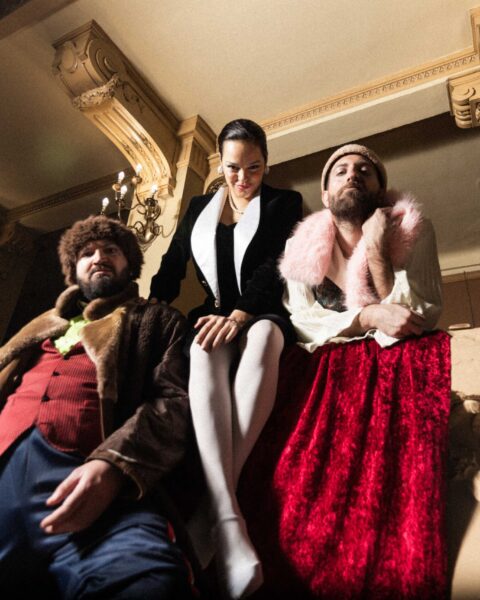
IPHIGENIAS
Georgia Karlatira

4 Iphigenias stand before the sacrificial altar …
A minimal austere stage, as befits Death.
Their starting point is a fantasy of the future ; one that is denied,collapsing under the weight of maintaining power and prestige.
Lives exiled, trapped beneath their own skin,
an inescapable sacrifice….


A theatrical performance based on excerpts from Euripides, Goethe, Yiannis Ritsos and from the monologue Iphigenia/Prey by Vivian Stergiou.


Directing approach
An archetype.
The daughter.
Her sacrifice.
How marriage becomes the sacrifice of the daughter?
How many daughters are sacrificed on this altar, to maintain social balance?
Αnd, how 4 different writers handle this sacrifice?
I break, I divide Iphigenia into 4  faces and Ι still have 1…


Duration: 60 minutes

SLADEK

Alt text

Ars Moriendi Theater Group Presents Ödön von Horváth’s “SLADEK”

Following a successful three-show run last season in Thessaloniki, Ars Moriendi Theater Group presents the political drama “Sladek” by the Austro-Hungarian playwright Ödön von Horváth in Athens. The play depicts the rise of fascism in the Weimar Republic, as engineered by the paramilitary “Black Army.”

Von Horváth’s play is set during the interwar period and the Great Depression, when inflation, unemployment, famine, poverty, and homelessness plagued Germany and drove people to desperation, providing an opportunity for extreme political groups, such as the Nazi Party, to win the hearts of the defeated and the poor. In Sladek, we see how social conditions lead “small” people to desperate acts and heinous violence, paving the way for dictators and fascists who exterminate anyone who stands in their way: women, homosexuals, Jews, communists, democrats.

The work predicts with terrifying accuracy the cycle of violence that was about to spread across Europe. The fascism of 1920s and 1930s Germany is no more, but History today creates similarities that urge us not to be complacent. Online hate speech, the impoverishment of language, femicides, xenophobia, homophobia, and television and internet populism compose the Eternal Fascism, as Umberto Eco calls it, which feeds on the natural fear of the different, on the feelings of humiliation of vulnerable social groups, and on our primal need to be heroes in our mundane lives.

“The hero,” however, “of Eternal Fascism is impatient to die,” and “in his impatience he usually sends other people to their death” (Umberto Eco). This is the story of Sladek and his comrades.


The production Sladek is presented under the auspices and with the financial support of the Hellenic Ministry of Culture and the Goethe-Institut Thessaloniki.


Duration: 80 minutes
Suitable age: 14+