This website uses cookies.

Learn more. Accept.
Αντιγράφηκε η διεύθυνση email

Event Category: Theater

BLUE

Alt text

BLUE by Anna Lemonaki comes for the third year from Geneva to PLYFA for a few performances.

It is a contemporary performative work where language is mixed with music. An actress and a musician tune in and bring the viewer to the heart of the personal truth hidden behind anxiety.

Man has always felt stress. However, we notice the generative causes of stress changing over the years. It’s different to be anxious because you learn that the Earth is not flat but round and afraid of falling into space, than to hear your heart beating faster and faster thinking you’re going to go into cardiac arrest.

Contrary to earlier times, where ignorance was what threatened man by causing him fear and anxiety, today it is over-information. BLUE is a performance that deals with endogenous and exogenous stress, its psychosomatic symptoms and the vulnerability of the individual . With a text as raw as poetic but also through the energy of rock and roll, the author of the play and actress on stage, Anna Lemonaki, exposes herself with disarming honesty, claiming to share universal but often unacknowledged questions .

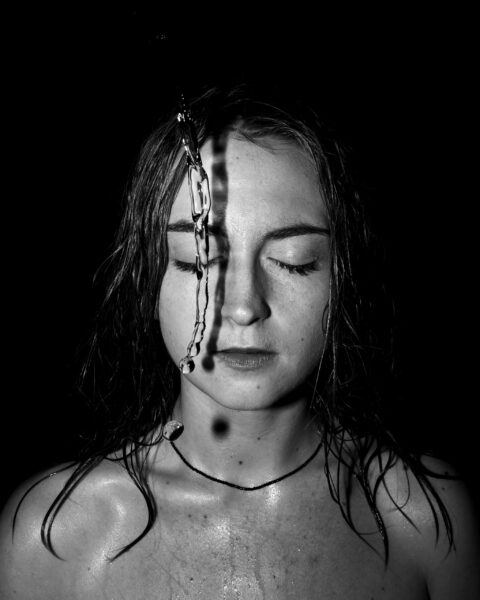
The dominant element of the show is water which nourishes everything and forever. A source of life and rejuvenation for nature and man, a symbol of purification and purification, water in continuous flow preserves and cleans the environment inside and around us, mobilizes the body and benefits the soul in many ways.

BLUE is the first part of a theatrical color pentalogy created by the theater group “Bleu en Haut Bleu en Bas” (Blue Above Blue Below) based in Switzerland and first presented in 2016 in Geneva. Since then, he has been hosted on theater stages in Greece, Cyprus, Switzerland, France, Lebanon, and at major international festivals (Festival La Bâtie, Festival Plein Tube, etc.). and will be performed at the Teatro de Barrio, in Madrid, in 2024.

After the success of her last project G.O.L.D. premiered at the Festival de la Bâtie in August 2022, Anna returns to Greece with Blue for a few performances only

In Switzerland, after Blue, Anna uploaded Bloody Fuchsia, White, G.O.L.D. (Glory or Little Dreams) and is now preparing Black – What a Beaty-Full Catastrophe which will be staged at the Comédie de Genève in 2025.

At the same time, she is preparing her first choreographic project and film Kiss and Fly.

Excerpt from the text

“Who’s afraid to swim over seaweed? Who is afraid of his tears? or smile more than he should? Old age? The aging dreams? Unemployment? And of course I’m talking about emotional unemployment. Responsibility; Bringing a child into the world? tell your child the truth? Open your palm and let your child fly wherever his appetite takes him? Do you forget the child you once were? Say No and support it? Say yes to risk. Say sorry when you’ve messed up. Sorry, I was bullshitting. WHO IS AFRAID TO OPEN THEIR EYES AND LOOK AROUND? To experience the happiness that knocks on your door? To open the door, to live a passionate love, do you remember when you were fifteen years old how you blushed in seconds on the cheeks, chest and hell?
WHO IS AFRAID OF LIVING A HORMONICALLY ALIVE LIFE?”

Anna Lemonaki’s note

40 million European adults aged 18 to 54 suffer from anxiety disorders. What happens when we suddenly become cautious about life and instead of living it we become mere spectators? Our first urge is to dive into the sea, but the water is cold. And we don’t want to take the risk of an ocean flu. We are careful and deprived of the ocean. I feel the need to state that anxiety disorders in any form should be a public issue and that is why I decided to do this project. The more and openly we talk about the faces of anxiety (panic attacks, phobias, post-traumatic stress…) the easier we will understand that this black surface at the bottom of the sea is nothing but seaweed and nothing else. BLUE is a manifesto of words and sounds against the stigma that accompanies mental illness.

Every creation is for me an opportunity to take a risk. I take risks by choosing subjects that scare me. These are topics that I find dizzying. In my work as a director, writer and actor I always work focusing on contrasts. Passing from certainty to uncertainty, from tenderness to cruelty, from a narrow passage to a vast space, from romance to vulgarity, from silence to scream, from tension

BIOGRAPHY OF ANNA LEMONAKI

Anna was born in Athens. It grows in Panama, Crete and Athens. He obtained a degree in Political Science in Athens and Bergen in 2006 and a master’s degree in Sociology and Media from the University of Friborg. He studied at the Serge Martin Theater School (Geneva) and graduated in 2013. He attends workshops with Susan Batson at Interkunst (Berlin, 2014 and 2017), with Andreas Manolikakis (President of the Actors Studio, New York) in Athens and with Damian De Schrijver (TgStan, Belgium) in Geneva in 2018. Followed by CAS in Acting and Text Dramaturgy at HETSR and the University of Lausanne (2018-2020).

Anna performs roles for Lena Kitsopoulou in Haire Nymfi (2013), Red Riding Hood – First Blood (2015) and Cry (2018-2021) at the Saint-Gervais Theater in Geneva and at the Techni Theater. He collaborates with, among others, Philippe Quesne, Nikos Karathanos, Adina Secretan, the theater company Cie Daniel Blake for the theater venture Opa (2nd prize – PREMIO 2017). In the cinema he plays the lead role in the film La nuit est encore jeune [The night is still long], directed by Sri Lankan native Indika Udugampola (Promising Director Award at the Colombo International Festival, 2015). She founded the experimental theater and music company Cie Bleu en Haut Bleu en Bas together with the musician Samuel Schmidiger (2015) and presented the first two parts of her quintet, BLEU and FUCHSIA SAIGNANT at the La Bâtie festival in 2019 and the third part BLANC ( SSA Prize, 2020) in Le Grütli (2021). Presents the show P.E.T.U.L.A. bye bye (2017) at the Saint-Gervais theater and at KET in Athens. She is invited by Le Poche theater and directs the play SAPPHOx, written by Sarah-Jane Moloney (2020). In 2002 he presents the G.O.L.D. at the La Bâtie festival. He works as a writer and dramaturg for the dance work Bis N.S (as usual) by the choreographer Ioannis Mantafounis at the Lyon Opera (2021) and the work A la carte at the Frankfurt Dresden Ballet Company (2023). In 2023/2024 he makes the dance-climbing performance and film Kiss and Fly in Leonidio and Tarifa and prepares the play Black : What a Beauty-Full Catastrophe (2025, Comédie de Genève, Geneva).

Interviews

LIFO
She writes and directs her plays herself, but the process that makes her happy is the second one, being able to compose her performances collectively and on stage. She is the only Greek woman active in the theater this side of Switzerland and I ask to know what this means for a foreigner, how she approaches the system.

EDITORS’ NEWSPAPER
For those of you wondering why the name is unfamiliar to us, the reason is simple: Anna has been based in Geneva for many years. There, in the context of the historic La Bâtie Festival, she presented her new work “G.O.L.D.”, a study of failure with poetry, humor and sensitivity, and a brilliant group of performers – we hope to see it in Athens.
Immediately after the last performance, in the heat of the moment, in the courtyard of a wonderful theater by the river, we talked about its progress. Here is Anna Lemonaki, a charismatic artist of the diaspora.

Critique

ελculture
Although the description of the – indeed bleak – theme of “Blue” could lead one to expect an almost unpleasant sight, this is not the case at all. This very closeness that its creator establishes between us and herself, leads to a redemptive condition. Like our fears, placed through her touch next to the fears of others, but also our own us, to be eased. As if the very democratization of trauma exorcises it. As if this moisture flooding the scene creates a matrix within which we can safely expose ourselves. And if the tension still brings a tear to our eyes, the most likely thing is that we will leave the room with a smile.

THE FOOD

Alt text

Maria Laina’s play “The Food”, after a successful cycle of performances (2018-19), is staged again, at PLYFA, directed by Dimitris Lioliou.

This play is performed in Greek.

15, 17, 22, 23, 29 & 30 March 2024
5, 6, 12, 13 23 & 30 April 2024

Eating in the theater is usually not allowed. Beyond the purely biological, the human need for food reveals and refers to more than one form of hunger. A powerful and idiosyncratic text of modern Greek drama for six unique performances.

Director’s note

An open dialogue about what we define as food. “Food is our innocent victim and we have to acknowledge that.” A death, the affirmation against life. How do we perceive this loss and how violent can the moment of coming of age be for each of us? What did we have to sacrifice and what did we substitute? The cannibalism of the self. The projections, the symbols and how abusively we swallow all that we feel in order to survive, to be satisfied. Two parallel and completely different testimonies that, while at first glance, do not converge, compose a pattern for how man perceives and deals with a traumatic experience.

The poet Maria Laina, on the occasion of the first upload of the show, said:

“However, I am impressed that a young man, with a lot of appetite, like Dimitris Liolios, was interested in such a text; wild, by the way, that has to do with loneliness and madness, with what we say or what others they say two in one. In the text, of course, the opposite happens, we have one in two, a schizoid condition. I confess that his glance excited me with curiosity and astonishment, and his overflowing enthusiasm persuaded me to leave it in his hands.’ (Interview on Sunday’s BHIMA)

For “The Food” they wrote

Katerina I. Anesti “Food, love, dominion, death, annihilation and again food, pleasure and rejection, and the unknown, the familiar and the unspeakable. Pollutants from the stage and Liolio and Lilikaki. You don’t see blood, flesh. But it’s there.” (protagon.gr)
Ioanna Vardalahaki “And after everything has been eaten, others, time, love, man turns to himself.[..] The heroes and their speech are the meaning, the performance and the scene.” (clickatlife.gr)

Kostas Zisis “A melancholic but deeply and essentially focused performance: a hymn to the Sisyphean suffering of man, to his eternal hunt for survival in the world: to the conquest of food and love. Because that’s the only way we survive.” (all4fun.gr)

Maria Mari “Without any image or stage object, it presents the viewer with this salivation, which accompanies the feeling of hunger and need, the vital need for food.[…] Sensation, pleasure, morbidity, melancholy , utter solitude, desolation.” (theatromania.gr)

Argyro Bozoni “Excellent work. Nice to get ahead of those who will say that such texts are difficult in the theater. No, they are poetic and easy, they tell a story that concerns us and we all know it.”

Dimitris Fallieros “You are struck by a show that talks about things that are not easy: about all forms of hunger, about love, about human psychosis, about the power of habit, about loneliness[.. ].’

SEBASTIAN

Alt text

Performing Arts Award 2023
From the Association of Theater and Performing Arts Critics

After its extremely successful presentation in May 2023, the performance “SEBASTIAN” by the group Nova Melancholia, directed by Vassilis Noulas, returns for six performances at PLYFA from February 6, 2024.

The show was honored by the Association of Theater and Performing Arts Critics with the Performing Arts Award for the 2023 artistic season.

Director’s Note
Sebastian is a polyprismatic archetype, a kaleidoscope, an avatar of desires and moods. Reflecting on the tradition of the martyrdom of Saint Sebastian, as it is reformulated through the dense figurative representation in Western art from the early Renaissance onwards, we focus on concepts / sensations / symbols that touch our own sensibility and imagination. The performance is the totality of its cultural references. We read poems, reenact paintings, act, pose, sing, dance, get inspired by the tradition of an eccentric, experimental cinema. We are interested in the co-emotional and embodied practices through which we today can relate to such a symbol.

Sebastian is associated with youth, beauty, sports, archery, carnal pain, hideousness, homoeroticism, martyrdom. A primary co-signification around Saint Sebastian (since the Middle Ages) is the Plague, the Black Death. We associate the tradition of homoeroticism around the figure of Sebastian, with the AIDS disease that was considered in the 80’s and 90’s a kind of “gay plague”. Like people at the dawn of European modernity, we too today resort to Saint Sebastian as an apocalyptic symbol of evil. The show is dedicated to those who take the risk to go from vision to experience, from representation to performance, risking the misunderstanding of existence.

More information about Nova Melancholia, and the performances it has presented, can be found at novamelancholia.gr

* The show is dedicated to HIV positive activist Zackie and experimental filmmaker Kenneth Anger who died in May 2023

THE LOVE LIFE OF ANIMALS

Alt text

This play will be performed in Greek.

In a lettuce garden, at the top of a tree, on the highest mountain, under a water lily and next to a stone take place five hilarious (or not) inclusive stories starring characters from across the animal kingdom and inspired by Alessandro’s book Boffa “You are a beast, Viskovic.”

A transsexual snail, a germ with an inferiority complex, a chameleon in search of identity, a dominant male moose and a suspicious finch introduce us to the wonderful world of animals, teaching us how important it is to be yourself. Or not.

In an attempt to render the world of animals with a human eye, we invade a parallel world where the characters, presented as animals, resurrect human stories.
The notes of the music travel with the plot and the images reach a world balanced between the human and the animal.
Questions deep and unresolved, make us wonder if the answers are always the destination, or if the questions ultimately give the journey a meaning.

AI GIORGIS

Alt text

A performance inspired by the short story “Ai George” by D. Hatzis.
Four actors construct the stage space in order to tell the story in a stage narrative that the constitution of the space and its boundaries are constantly undermined
The question that arises is one and it comes back in multiple ways • the weakest of us humans, how do they live? Can they be happy, fall in love, have a right to dream of the piece of the pie we call collective happiness?
No matter how guarded you are, no matter how small your dreams are, no matter how humble you approach your happiness, when you are on the side of the “defenceless” even Love or Light can tear you down, burn you
A show about people who try to live like everyone else and fail
In the performance, a short excerpt from G. Kontrafouris’ play, “The children mourn” (1997) is heard.

AGOROMANA

Alt text

This play is performed in Greek.

“This load of logistics that mom has on her head is huge! To take a break from what I live, I go to the greengrocer, my friend…”

A new mother finds that raising children under conditions of social pressure and incessant “well-intentioned” instructions ends up being an arduous and intensely lonely job. Is she the only one who feels this way? Is she a bad mother?

Aphrodite Mitsopoulou’s play Agoromana continues for a 2nd theatrical season in Athens and returns in January 2024 to the PLYFA stage. The work explores, chronicles and deconstructs the experiences of motherhood and fatherhood, gradually illuminates gender roles that continue to exist today, and boldly unravels the thread of violence against women*.

Between stand-up comedy, documentary and musical performance, Agoromana is an honest opening into the world of motherhood and parenthood in general. Aphrodite Mitsopoulou and Iakovos Molymbakis manage to exonerate the negative emotions that can torment a new parent and embrace the embarrassment and insecurity he experiences. In a world of superficial perfection, mistakes and confusion serve as a reminder that we are human.

Each show features different guests on stage, who share their own parenting story.

“Motherhood is like a sacred thing that everyone respects — until you get the trolley that everyone curses you for having a stroller to get into at 15.”

“You basically fall into the sea and swim. And it’s a storm.”

“Anyway, I’m not having a child with a man again.”

*During the show there are clear references and descriptions around the issue of obstetric violence. If you are a victim of obstetric violence, do not hesitate to seek help and support from certified professionals and agencies.

DESCENDANTS

Alt text

“The Descendants”, a story about two brothers who never met. A devised musical performance in dramatic composition and interpretation by Iros Bezos and Christos Thanos, at PLYFA from January 11, 2024.

This play is performed in Greek.

Two brothers meet for a once-in-a-lifetime moment, just to fulfill the prescribed debt, which the deeds of their ancestors determined. An eternal story about the unbearable burden that is carried from generation to generation and comes to settle, unshaken, on the backs of the last descendants.
There are no more ideal figures in the world theater to express the consequences of this burden than Electra and Orestes.

The performance consists of texts by Yiannis Ritsos, of ancient tragedies as well as originals, placed in a musical universe.
The music is performed live with the participation of Panagiotis Gikas and Teos Foinidis

WHY DID YOU PROMISE ME SUCH A NICE DAY?

Alt text

How ephemeral can a love be – close to the waves?
A half-baked love, a two-way love, a love in the imagination or not.

HATE!
Shakespeare does not care so much for the aesthetic effect, he is a master of reasoning and adventure of feeling. He seems to be overseeing the whole world but never forgetting death.

If we went on a trip to the sea?

You have sand in your towel,
Watermelon on your lips,
November in your summers.

The students of the 3rd year of the Theater School “delos” – Dimitra Hatoupi present the performance
“WHY DID YOU ORDER ME SUCH A NICE DAY?”

Based on Shakespeare’s 154 Sonnets realized through forty days of research using improvisations of voice, rhythm and the function of the choral condition.

Let’s swim together.

There will be a financial assistance box for the expenses of the 3rd Year degree exams.

MEDEA LOADING

Alt text

“This is not Medea”
(excerpt from the Medea Material,
by H. Miller, mtf. E. Varopoulou).

INVITATION TO TEA

As a modern female being, Medea invites us to a tea ceremony to tell us her own story of grief and liberation.

If Medea were a place, what place would it be? What does Jason carry with him? What do Medea’s children drink? Where does Medea dwell within us? Does love pass? How is the past exorcised? And after all, what shoes are suitable for a climb in the sun?

Please be open to revising what you take for granted about the mythical figure of Medea. It is a cry for survival, an ode to motherhood, an appeal to tenderness, an ecstatic dance of liberation, where Medea, light in a crumbling world, calls for rebellion against the socio-political dictates of her gender.

Dresscode: Wear something in shades of croc or something that evokes natural or primitive materials, or whatever makes you feel your deepest self.

The solo show is made possible thanks to the financial contribution of many unique people and thanks to the undivided research and dedication of the team members.

Trailer

VAIZA

Alt text

EDIT. arvan (girl, daughter)

directed by Christina Matthaiou

Play performed in Greek

Extension of performances thanks to the warm response of the audience! “vaiza” will return to PLYFA for 3 more performances on January 18, 24 & 25.

The show that thrilled the audience and critics and stood out at last year’s Epi Colonos Off-Off Festival, returns for the second year, from December 4 and for only 10 performances, at the “PLYFA” theater in Votanikos.

Christina Matthaiou, in her first directorial venture, brings on stage the original work “vaiza” {ETYM. arvan “My speechless apple” and “Christ in the snow” and inspired by the myth of La Loba, as he is captured in Clarissa Pinkola Estes’s book “Women Who Run With the Wolves”, he composes a performance that speaks of the power of femininity. The power to break, to expose, to be imperfect, to differ, to define yourself, to feel, to express, to live!

Mani, mid 19th century.

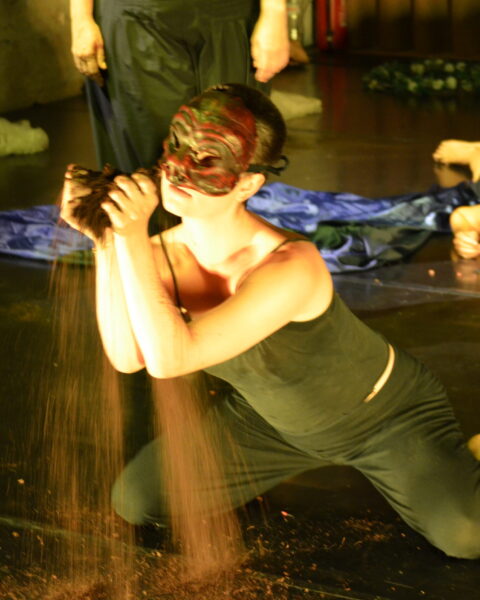
A young woman, Milia, is murdered by her father and brothers to wash away the shame of the family, after she was found “broken” on the first night of her wedding. She is buried alive in a stone pit at the entrance of the village. Only her head remains out of the soil until she dies. Now Milia has a voice. Now La Loba is giving her the chance to tell her story. To be reborn.

Without limiting itself to describing yet another femicide, the play explores the perspective of each of those involved. Six persons who have never spoken, captive to social dictates and formality, now speak.

Drawing material from the Greek tradition and the overall European and Balkan history, the show speaks about today.

Director’s Note

Remember that sound you hear when you’re under the surface of the sea? And as your oxygen runs out, and the force of the water pulls you out, you struggle to hold on. There. Inside her. Listen for a little while longer, this primitive sound that brings you back. In the womb of life.
They say that tears are made of sea water, so that when people cry, they can bring the sea closer to them. And let her, the great mother, come like this to accompany them when they need her.
When they are in pain, when they mourn but also when their happiness is so great that it causes the water in their body to rise, so much so that they are in danger of drowning. And they cry. To get the excess sea out of them.

“Don’t let sorrow become a tear, Don’t let pain become a cry…”

Have you ever noticed the cheeks of women who have lost children? It’s as if the sea cursed them to never dry up. To keep her there to keep them company.

“Not a drop will escape you for the dishonorable! He embarrassed us and he will pay. She should go unscathed.”

And the sweat? What is sweat?
Water too. Seafood. Because when the sea and the fire of love meet, they become sweat. Which comes out of the bodies in love, so that one of the other can know the sea. The sea that swells inside them.
But man is not only made of water.
It is also soil. Earth. Who expects you to return her children to her, when the sea dries up in them. And when she closes them in her bowels, again, by watering them with sea, she gives birth to them again.

“You have to listen to the soil. Smell it. Taste it.”

And the ashes? What is ash?
She is also a lover’s dust. Burned bodies, before the sea touched them to cool them. Voices. Where they don’t run out of air. And they are silent.
Losses. And presences that “exist in absence”.
“Have you ever seen the fire forbid the coals?”
And the ending? Death;
“The end does not recognize death”
Why “are you killed, lost, if you are thought of by a myriad of names?”
Water, earth and fire meet on stage. In a ritual of mourning and rebirth. A performance made with materials of land and tradition. A project entangled in roots that pull it to the past. And four voices. Air. Which carries the dusty memories of all our bloody history to the water. Which will wash them away and lead them to purification. Water will make them again.
“Because time is water. Water that sculpts the stone like the sea the rocks
(…)
And richer water than tears, none.”
Christina Matthaiou